

About Biodynamics
What Is Biodynamics and How Does It Work?
Pain, fatigue, and the sense of being disconnected from your body are often complex, multidimensional experiences.
Conventional medicine can offer answers—and sometimes, relief. But not always. In those cases where physical symptoms persist without a clear cause, or when emotional stress translates into somatic discomfort, biodynamic therapy offers a complementary approach grounded in the body’s natural capacity for regulation and repair.
Our bodies store implicit memories—what could be called the physiological echoes of lived experience. Unresolved events can remain imprinted in muscular tension, posture, and patterns of reactivity.
When the body is given space to express what was left incomplete, to “speak” its story through sensation and subtle physiological shifts, the self-healing processes that are already built into us can begin to unfold. Biodynamic therapy facilitates this process by supporting the body’s inherent drive toward balance and integration.
Understanding the Origins of Pain and Tension
The human body is not only a biological structure—it is a dynamic system in constant interaction with time, memory, and environment. It remembers past events, prepares for future scenarios, and responds continuously to present stimuli. These processes shape how we move, how we hold ourselves, and how we feel. Someone who once experienced a fall may subconsciously brace themselves each time they encounter stairs.
Someone living with chronic anxiety may clench their jaw for years, eventually developing migraines or neck pain. These are not just “habits”—they are adaptive responses rooted in the body’s history.
Pain and tension often reflect an incomplete stress response. In a healthy cycle:
The nervous system detects a threat.
- The body prepares for fight or flight.
- Hormonal and metabolic resources are mobilized.
- Action is taken.
- The threat passes, and the system discharges the energy and returns to equilibrium.
However, when the cycle is interrupted—due to trauma, overwhelming emotion, or lack of support—this energy remains suspended in the system. The body stays on alert. Muscles stay braced. The mind may move on, but the nervous system continues scanning for danger. Over time, this can result in chronic tension, fatigue, disrupted sleep, and eventually, a state of depletion. When neither fight nor flight are possible, the system may shift into freeze: a shutdown mode designed for survival.
Pain, in this context, is not just a mechanical issue. It is a signal—an intelligent message from the nervous system that something requires attention. For healing to begin, the system must first perceive safety. Without this, the body cannot shift into the physiological state necessary for restoration. Biodynamic sessions create the conditions for this shift. Through non-invasive, attuned presence, the therapist supports the body in recognizing: “It is safe now.” That recognition is the gateway to healing. Stillness follows.
How Biodynamic Therapy Supports Recovery
Stillness—a core concept in biodynamic work—is not merely the absence of movement. It is a deeply regulated state of being in which the body is at ease, the mind is quiet, and the nervous system is no longer searching for threat. This state cannot be imposed. It emerges when the body feels safe enough to stop bracing.
The primary role of the biodynamic therapist is to establish conditions of relational and physiological safety. This begins with deep respect for the body’s boundaries. From a neurobiological perspective, boundaries are not abstract—they are vital signals used by the brain to assess whether proximity is safe or threatening. A therapist who honors these limits helps regulate the system, even before touch occurs.
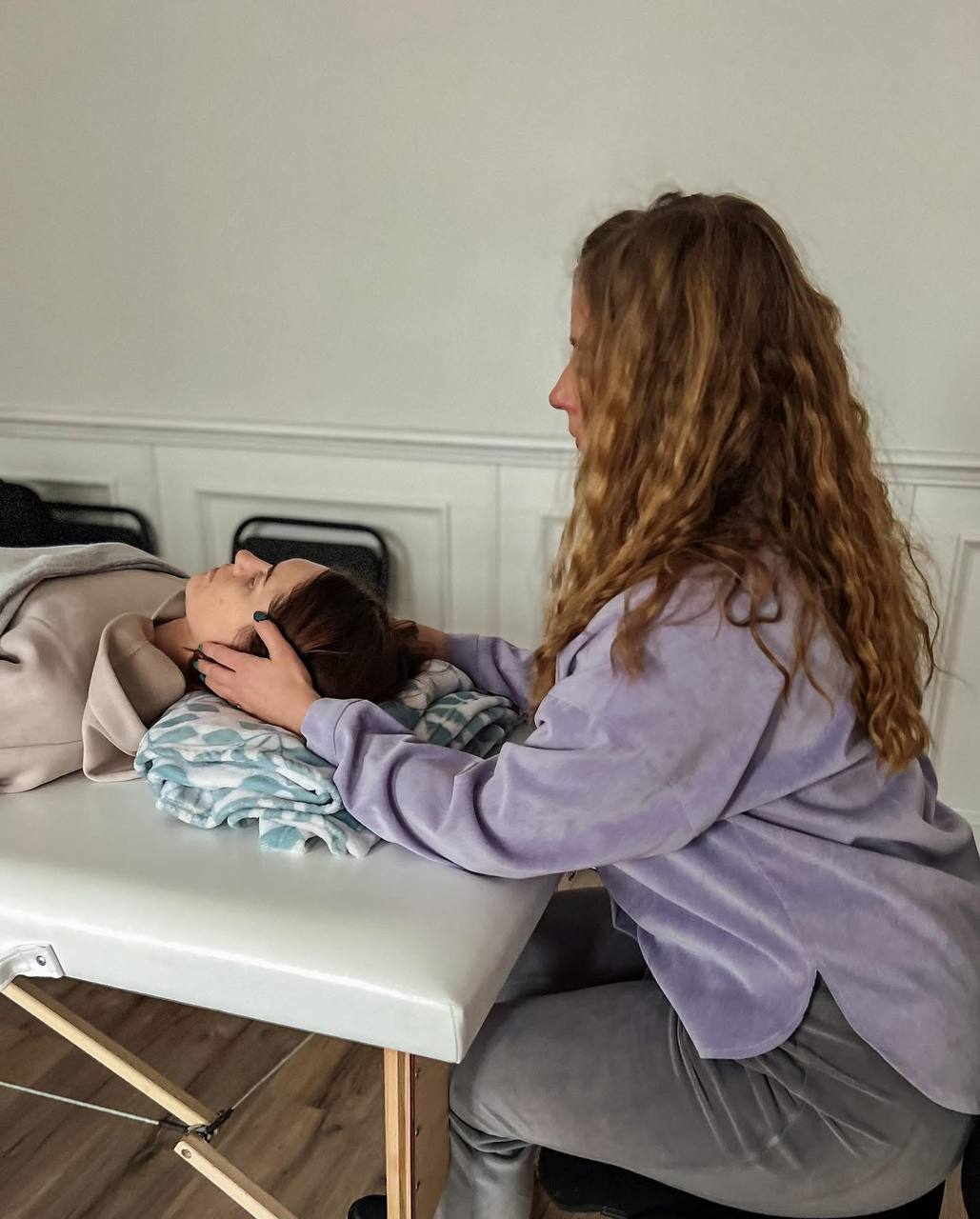
Everything the therapist communicates—voice tone, posture, pace, micro-movements—contributes to the dialogue of safety. In biodynamic language, we refer to the recipient of care as the “person on the table,” not a patient. Therapy is not something done to someone—it’s a process we enter with them. The nervous system is exquisitely sensitive to this quality of relational presence. When the body detects enough signals of safety, it begins to unwind.
Using a biodynamic touch—light, steady, and receptive—the therapist listens for the body’s priorities: what it’s ready to address, and how. Physiological cues emerge: shifts in temperature, muscle twitches, waves of sensation. These are not symptoms to be “fixed”—they are expressions of internal regulation in progress. The therapist follows, not leads. When the process completes, the body settles into stillness. Often, pain and tension diminish, not through force, but through resolution.
What distinguishes biodynamic therapy is its gentleness and its depth. Sessions often evoke a profound sense of rest, sometimes compared to time spent in a retreat or a deeply restorative environment. This state of calm is not an end in itself—it is the foundation for long-term regulation, resilience, and integration.
Biodynamics and Conventional Medicine: How They Can Work Together

For those unfamiliar with biodynamics, it can sound abstract—even a little mysterious. I understand why. Biodynamics is a specialized branch of craniosacral therapy, which itself evolved from osteopathic principles. And osteopathy, especially outside the United States, is still met with skepticism in some medical communities. Yet in the U.S.—where osteopathy originated—practitioners can be fully licensed physicians with medical degrees, trained in both conventional and osteopathic medicine.
I’m a physician myself. I know the boundaries of clinical responsibility and the importance of evidence-based practice. At the same time, I also see how biodynamic work can support healing in areas where conventional approaches may have reached their limits—especially when the issue lies not in the tissue, but in how the nervous system processes experience.
The Brain, the Body, and What We Don’t Always Control
The body is regulated by the brain—but not always by the parts we consciously identify with. The neocortex—the thinking, rational brain—is evolutionarily young. It’s easily overwhelmed. Most of what governs survival, emotion, and behavior comes from older brain regions like the limbic system and the amygdala. These areas operate largely beneath conscious awareness.
We spend much of our lives on autopilot. Our habits, stress responses, and behavioral patterns emerge automatically—and yet they shape our health in very real ways. That’s why, in cases of chronic illness or persistent symptoms, I believe healing is most effective when two kinds of professionals are involved: a physician and a psychotherapist. The choices we make—how we live, think, and relate—don’t just affect our mental health; they shape the course of physical illness and recovery.
So it makes sense that physicians often recommend reducing stress, prioritizing rest, or spending more time with loved ones. These aren’t soft extras. They reflect something medicine is beginning to understand more deeply: the nervous system and the mind directly influence the body’s physiology.
Health Also Means Quality of Life
One of the limitations of conventional medicine is its tendency to view the body as a collection of parts—bones, joints, fluids, symptoms. Or to focus solely on solving the clinical problem. But a body belongs to someone. Behind every diagnosis is a person—and that person’s experience matters.
The idea of treating the whole person is often associated with “holistic medicine,” which doesn’t always meet the criteria for scientific validation. But in practice, good clinicians—those trained in evidence-based medicine—often work holistically in the best sense. They pay attention not only to lab results, but also to how a person is sleeping, functioning, and coping emotionally. If anxiety is making it hard to rest, a responsible physician will address it or refer to someone who can. Because restoring sleep and reducing stress aren’t just supportive measures—they’re part of the recovery process. They improve compliance, reduce suffering, and lead to better outcomes overall.
Beyond the Prescription: The Power of Presence
Some people do everything “right”—they take their medications, follow their doctor’s guidance, go to therapy, exercise—and still don’t feel better. Their condition stabilizes, but they remain stuck. The body doesn’t shift. The symptoms linger.
What makes a difference then? Often, it’s not a new treatment, but a different kind of attention. A practitioner who listens closely. Who doesn’t rush. Who asks not only about the pain, but about the life around it. Sometimes, people find themselves in the office of a practitioner—maybe a homeopath, maybe someone outside the conventional system—not because of the remedy itself, but because of how they are seen. Because something is offered just for them. It feels personal, meaningful, attuned.
Call it placebo? Possibly. But placebo is not “nothing.” It’s the body’s response to expectation, belief, and emotional context. In fact, a 2021 study from Harvard Medical School showed that placebo alone could account for up to 50% of pain relief following a migraine. A Cleveland Clinic specialist explained it this way: “The more confidence and positive expectation a person has about a treatment, the more likely it is to work.”
This is not fringe science. It’s neuroscience. And in biodynamic work, this is the space I hold: the space where the body, brain, and relational presence come together. When the nervous system feels supported, it begins to reorganize. The relief people experience is real.
How Biodynamics Complements Conventional Care
“Complement” is the key word. Biodynamic therapy does not replace medical treatment—it supports it. It helps the system regulate, integrate, and respond more fully to what conventional medicine is already doing. That’s why I don’t treat diagnoses. I don’t claim to “fix” what has been identified and addressed by a physician. My focus is to support the person who is living with the condition: to help them feel more resourced, less burdened, and more able to engage with their healing process.
I think in terms of suffering—what can be eased, what can be softened, what can be met with presence. If I can help reduce pain or prevent additional strain, I will. But I also believe deeply in professional boundaries and collaboration. If I sense that someone needs medical evaluation or intervention, I say so—clearly and compassionately. I refer when needed. I also name what I can do, and where my scope ends.
That clarity helps people navigate their care more confidently. It prevents the all-too-common confusion that arises when modalities compete instead of collaborate. For someone who is already vulnerable, this kind of fragmentation is often the most harmful thing of all.
Collaboration Is the Future
Healing works best when the person is supported by a team of professionals who understand their roles and respect one another’s contributions. The client stays at the center. The approach flexes around them—not the other way around.
When clients are active participants in their care, and practitioners bring both rigor and humility—both structure and meaning, science and humanity—that’s when real healing becomes possible.
That’s the kind of medicine I believe in.
How Long Does It Take to Heal with Biodynamic Therapy?
People often ask: How many sessions will I need to feel better? And the honest answer is—it depends. Just like in conventional medicine or psychotherapy, healing doesn’t follow a fixed timeline or protocol. It unfolds at the body’s pace, depending on many individual factors.
But here’s the good news:
- Most people feel some relief after the very first biodynamic session.
- With each session, the effects tend to deepen and build on one another, as the system begins to recognize safety and trust the process.
Biodynamic therapy works cumulatively. Often, a single session is enough to spark a meaningful shift—whether that means deeper rest, more ease in the body, or simply feeling more like yourself again. You’re free to choose a rhythm that works for you.
In my practice, some people come once and feel complete. Others attend regularly, week by week. Some return after months or years when their body calls for it again. All of these rhythms are valid. What matters most is that you feel supported—and that your body has the space and safety it needs to respond.
What Healing Depends On
In biodynamic work, healing is something the body does for itself. That’s one of the central principles. The human body is inherently intelligent—it knows how to restore balance when the conditions are right.
Of course, many illnesses or injuries require medical diagnosis and intervention. That’s where conventional medicine is essential. But sometimes, even with good care, the body doesn’t settle. Symptoms persist. That’s when biodynamics can help—by gently working with the nervous system and supporting regulation from within.
The role of the biodynamic therapist is not to fix or force, but to create the conditions where healing becomes possible. These conditions are different for everyone. In general, for the body to release tension or pain, the brain must first register that it is safe.
One key structure in this process is the amygdala—part of the brain’s threat detection system. When it senses no danger, it begins to ease its grip. Areas of the body that were previously “guarded” or held in chronic tension may begin to soften, shift, and reorganize.
Healing becomes possible when the brain no longer feels the need to protect. How quickly that happens depends on many personal factors: the intensity of one’s protective responses, the depth of unresolved trauma, the system’s sensitivity to external or internal triggers.
These aren’t flaws or malfunctions—they’re reflections of how each person has adapted to their life experiences. And because each system is different, there is no way to predict how many sessions it will take to calm the amygdala and invite the body into repair.
A responsible biodynamic therapist won’t make promises or projections. Instead, we meet the system gently, respectfully, and let relief arrive in its own time—gently and organically, as the body begins to feel safe enough to let go.
What Biodynamics Offers—Even After One Session
At the heart of biodynamic therapy is the person: their sense of safety, their rhythm, their boundaries. The work begins exactly where the nervous system allows. In biodynamics, we call this the agenda—the body’s natural set of priorities for that particular moment in time.
Even after a single session, you may experience:
The therapist listens to the body’s agenda and works within the parameters set by the nervous system. This approach is never forced. It meets you exactly where you are. Every release—however small—is a meaningful step in the process.
You are always welcome to choose a rhythm of therapy that feels sustainable and right for you. That might mean one session to explore, a regular rhythm of ongoing work, or periodic support when needed. Sessions can be held in person or online.
And if you’re unsure what kind of rhythm is right for you, I’ll be glad to help you find one that feels both effective and grounded in comfort, clarity, and care.
Can (and Should) You Learn Biodynamics?
Yes—you absolutely can. In fact, almost anyone can. Many students at the School of Biodynamics and Integrative Somatic Practices first came to me for a session. They felt something shift—quiet, subtle, but undeniable—and realized they wanted to understand it. They wanted to know how biodynamics works, how to support themselves and their loved ones, or even how to bring this work into their profession and become biodynamic practitioners.
One of the great gifts of biodynamics is how deeply practical it is. Every tool it offers is designed to create a sense of safety, honor bodily boundaries, and give the system the conditions it needs to restore itself. These are skills you can begin using right away. How far you choose to go with them becomes clear over time. But this much is certain: even your first encounter with biodynamic work can profoundly shift how you relate to your body—and your life.
What Kind of Knowledge Does a Biodynamic Therapist Need?
Biodynamics is both simple and profound. You don’t need specialized credentials to begin this work—not a medical degree, nor a background in manual therapy or psychology. What you do need is something more essential: to be human. To meet others with respect, to listen well, to sense boundaries—your own and theirs—and to hold them with care.
Biodynamics emerged from craniosacral therapy (CST), which itself developed out of osteopathy. In that sense, it’s part of the osteopathic lineage—but it offers a fundamentally different view of the body.
In osteopathy and CST, there’s often an implicit idea that the body should be organized in a certain way, and that anything “off” needs to be corrected. Biodynamics, by contrast, trusts the body’s inner wisdom. It doesn’t impose or fix. It creates conditions in which the system can rebalance itself, in its own time and on its own terms.
Biodynamics is not about dysfunction—it’s about health. It’s a practice of trust, safety, and deep listening. It’s non-invasive, non-corrective, and rooted in the belief that the body already knows what to do—if it feels supported.
The “professional skills” of a biodynamic therapist are mostly what we now call soft skills: attunement, presence, patience, emotional awareness. These are the qualities that help people feel safe—and safety is what allows the nervous system to soften its defenses and move toward healing.
How Biodynamics Supports the Therapist Too
I sometimes say that in biodynamics, the biodynamic therapist is the one with the steadier stillness. It’s a joke—but like most good jokes, there’s truth in it.
There is no hierarchy in biodynamic work. No one “knows better.” That’s why we speak of “the biodynamic therapist (the person with hands on)” and “the person on the table (the one receiving touch)”—not a “patient” or “client.” It’s a meeting between equals. The body tells its story. The biodynamic therapist listens.
Every person has an inner stillness—a quiet resource within. Everyone can learn to find it, rest in it, and offer it to others. Most of us have felt this: the calm of being near someone who’s simply present. Not doing anything special. Just being. And in their presence, we feel safe.
Stress, trauma, and unfinished experiences can disrupt our access to this stillness—but it’s something we can reconnect with. Biodynamic therapists know how to return to this space and how to hold it for others. It’s part of the practice.
To support others, a biodynamic therapist must first know how to support themselves. Their primary tools are presence, attention, and stillness. And while it may sound paradoxical, the first step in working with someone else is learning how to stay present with yourself.
This is why the principles of biodynamics are useful for everyone. Today, you might be in the role of the one with hands on. Tomorrow, you might be the one on the table. Both roles are equally human.
How Do You Learn Biodynamics?
Biodynamics can only be learned in relationship. It’s not something you can absorb through theory alone—you have to practice it, feel it, experience it with others.
One of the first questions to ask yourself is: How do I want to use this work?
Do you want to support yourself and your loved ones? Or integrate it into your professional path?
At the School of Biodynamics and Integrative Somatic Practices, we offer several options:
Self-Regulation Course A four-session program for those who want to strengthen their relationship with their own body. It’s for anyone seeking to feel more grounded, more attuned, and more capable of self-regulation. We focus on grounding, breath pattern, boundaries, and body image.
From what I’ve seen, once someone begins learning biodynamics, the work often draws them in. Just start. You’ll know, in your own time, how far you want to go.
Biodynamics: Frequently Asked Questions
No, biodynamic therapy is not painful — and it should never be. Everything that unfolds during a session should feel easeful and respectful to the person receiving the work. It is the therapist’s task to create those conditions.
The core principle of biodynamics is that the body holds its own intelligence and knows how to heal. What it needs most is a sense of safety. When the nervous system begins to feel safe, it can start letting go of protective patterns and allow the healing process to unfold.
Safety arises from genuine comfort — physical, emotional, and relational. Any form of discomfort may be perceived by the nervous system as a threat, instantly reactivating defense mechanisms. That’s why all therapeutic contact must feel slow, respectful, and non-intrusive.
Communication during a session is essential. Let your therapist know what feels supportive — and especially what doesn’t. This ongoing feedback helps shape a space where your body can begin to settle and trust.
Biodynamic therapy can benefit anyone — because every body carries its own story. Stress, whether physical or emotional, is a natural part of life. But when a stressful experience is not completed, its energy may remain stored in the tissues. This might show up as pain, tension, reduced mobility, emotional restlessness, or even a subtle sense of disconnection.
Each person has a unique bodily “biography.” Some of those stories are finished, but many are not. Biodynamic therapy helps the body find resolution. When a cycle is gently completed, the stored tension can be released, circulation improves, and inner space becomes available again.
Because every body holds unfinished stories, biodynamic work is widely relevant. It supports physiological regulation, nervous system rest, and emotional grounding. Many people describe biodynamic sessions as deeply restorative — often more restful than sleep.
There are no contraindications for biodynamic therapy. A contraindication typically exists when a treatment could do more harm than good — but biodynamic work doesn’t operate on that axis. Here’s why:
- It is non-invasive. A biodynamic therapist doesn’t impose change or interfere with your body. The approach is rooted in deep respect for your personal process. It’s not about “fixing” but about creating the right conditions for your own healing to emerge.
- The person receiving the work leads.Nothing happens without your consent, comfort, and readiness. A biodynamic therapist supports the healing process but doesn’t direct or control it. They don’t assume to know what’s “right” for you. That knowing lives in your body — the therapist simply listens and follows.
- It is always individualized. Biodynamics offers principles and methods, but no formula. Every person and every moment is unique. A skilled therapist responds moment by moment to what your system expresses and adjusts the work accordingly.
In this way, biodynamic therapy is inherently safe. It doesn’t override or push — it listens and responds. That’s what makes it so powerful.
Усе, що відбувається на біодинамічному сеансі, має бути комфортним та максимально
кастомізованим.
Тому ця робота не може нашкодити. Вона помічна кожному, адже покращує якість життя.
A biodynamic therapist is not a fixer or a doctor — they are a facilitator. Their role is to support your body’s own healing intelligence, not to impose change. The body already knows what it needs in order to regulate and return to balance.
The therapist’s task is to create the right conditions, not to be in charge. The magic of biodynamics happens in that relational space — where one person holds presence with care, and another begins to soften and return to themselves.
A good biodynamic therapist:
- honors your body’s timing and intelligence.
- listens to you and prioritizes your comfort, agency, and choice.
- works in a way that fosters deep safety and regulation. When the nervous system feels held, the body can release its defenses.
- invites ongoing feedback and gently helps you tune in to your body’s signals, without pressure.
It’s okay if this kind of communication doesn’t happen right away. A good therapist will continue to offer that invitation with patience and warmth. That steady presence — without expectation — is itself an act of care.
If something feels off — physically, emotionally, or relationally — it’s okay to say so. Your body’s experience matters. A biodynamic therapist should adjust their approach. And if not, it’s perfectly valid to explore working with someone else. Your safety and comfort are essential.